
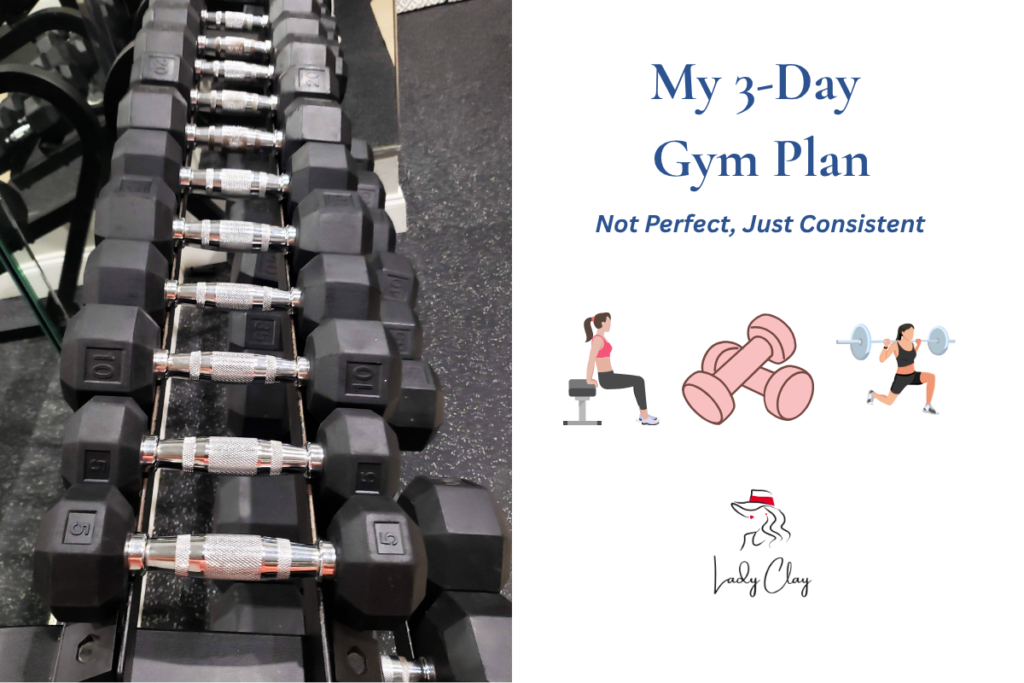
This isn’t the “best” workout plan on the internet. It’s not designed by a celebrity trainer, and it won’t promise you abs in 30 days. But it’s my 3-day gym workout plan for women, and it’s the one that keeps me going.
A few weeks ago I shared what I eat before and after a workout with Type 1 diabetes: the overnight oats, the boiled egg, the protein shake, and the toddler-to-daycare rush before I even get to the gym. Many of you asked the next question: “Okay, but what do you actually DO at the gym?”
So here it is.
The gym has become my place. It keeps me sane. It helps me focus. For an hour, it’s just me, my playlist, my glucose, and the next set. And lately I have noticed something I didn’t expect so soon: I feel stronger. Lifting my son, carrying groceries, climbing stairs. It all feels a little easier.
My Weekly Schedule (Real-Life Version)
I rotate between three workouts: Legs & Glutes, Upper Body, and Full Body + Core. Some weeks I make it to the gym 3 times. Other weeks it’s 2, depending on our schedule, my toddler, work, and sometimes my blood sugar.
Instead of “skipping” a workout, I just pick up where I left off. If I did Day 1 and Day 2 this week, I start next week with Day 3. Every muscle group still gets worked, and I never feel like I’ve fallen behind.
A 3-day week looks like:
| Day | Workout |
|---|---|
| Monday | Day 1: Legs & Glutes |
| Wednesday | Day 2: Upper Body |
| Friday | Day 3: Full Body + Core |
A 2-day week looks like:
| Day | Workout |
|---|---|
| Tuesday | Next workout in the rotation |
| Thursday or Friday | The one after that |
On rest days, I try to walk, stretch, or just chase my toddler around (that counts!).
The rules I follow:
- 5-minute warm-up before every workout
- At least one rest day between gym days
- 3 sets of each exercise, 90 seconds rest between sets
- Pick a weight where the last 2 reps feel hard, but my form stays clean
- When all 3 sets feel easy, I add a little weight (2.5-5 lbs) the next time
Day 1: Legs & Glutes (about 50–60 minutes)
- Battle rope alternating waves: 3 × 30 seconds (warm-up)
- Dumbbell Romanian deadlift: 3 × 12
- Seated leg press: 3 × 12
- Dumbbell stationary lunge: 3 × 10 each leg
- Leg extension: 3 × 20
- Hip abduction machine: 3 × 15
- Hip adduction machine: 3 × 15
- Dumbbell calf raise: 3 × 15
- Hamstring bridge hold: 3 × 30 seconds
My tip: Romanian deadlifts felt awkward at first. Think “push your hips back,” not “bend down.” It clicked once I thought of it that way.
Day 2: Upper Body (about 50–60 minutes)
- Chest press machine: 3 × 12
- Wide-grip lat pulldown: 3 × 12
- Shoulder press machine: 3 × 12
- Single-arm dumbbell row: 3 × 12 each arm
- Cable rope face pull: 3 × 12
- Dumbbell lateral raise: 3 × 12 (go light!)
- Barbell bicep curl: 3 × 12
- Cable tricep pushdown: 3 × 12
- Plank + side plank: 3 × 30 seconds each
My tip: Machines are your friend when you’re starting out. They guide the movement so you can focus on feeling the right muscles.
Day 3: Full Body + Core (about 45–55 minutes)
- Battle rope waves: 3 × 30 seconds
- Dumbbell goblet squat: 3 × 12
- Glute bridge hold: 3 × 30 seconds
- EZ bar upright row: 3 × 12
- Farmer carry march: 3 × 40 steps
- Hanging leg raise (Roman chair): 3 × 12
- Hollow body flutter kicks: 3 × 30 seconds
- Dead bug: 3 × 10 each side
My tip: Farmer carries look simple, but walking with heavy dumbbells is one of the most “real-life” strength moves there is. Hello, car seat and diaper bag.
Lifting Weights With Type 1 Diabetes: What I Keep in Mind
Working out with T1D takes a little more thought than just grabbing your water bottle. Here’s what I do:
- I check my glucose before I start, and I keep an eye on it during my workout.
- I always bring fast-acting carbs in my gym bag, just in case.
- I don’t work out on an empty stomach. My pre-workout breakfast is in my workout food post.
- I check again before deciding on my protein shake or meal.
- I give myself grace. Some days my blood sugar has other plans, and I shorten the workout or stop. That’s okay.
Everyone’s body responds differently to strength training. Some people go up, some go down, and it can change from day to day. Please don’t use my routine to guide changes to your insulin. Talk with your diabetes care team about exercising safely.
Why Lifting Weights Matters for Women
I used to think light weights and lots of reps were the way to “tone.” It turns out toning is building muscle, and that needs weights that challenge you. Lifting won’t make you bulky. It makes you stronger, firmer, and more confident.
What helps me most:
- Eat enough, especially protein. I aim for about 20–30 grams per meal (eggs, Greek yogurt, dal, paneer, fish, chicken).
- Drink water throughout the day, plus more on workout days.
- Walk on rest days. It helps my energy and recovery.
- Sleep. Muscles grow while you rest.
- Be patient. Many women feel firmer in 6-8 weeks and clearly stronger in about 3 months.
The Real Reason I Keep Going
Honestly? It’s not just about my body. It’s my reset button. Toddler mornings, running a business, managing T1D, a hundred thoughts at once… the gym is where my brain finally gets quiet.
Some days I don’t feel like going. I go anyway, and I’ve never regretted it. And on weeks when I only make it twice? That’s still a win. Two workouts are always better than zero.
As I said in my last fitness post, consistency matters more than perfection. You don’t need the perfect plan. You need one you’ll actually stick with. This is mine.
Do you have a gym routine that keeps you sane? Share it in the comments. I’d love to hear what works for you!
FAQ
Is working out 2–3 days a week enough for women to build strength?
Yes. Two to three strength sessions a week is enough for most women to build strength and muscle. Rotating between lower-body, upper-body, and full-body workouts ensures every muscle group gets trained, even on 2-day weeks.
Can you lift weights with Type 1 diabetes?
Yes. Many people with Type 1 diabetes strength train safely. Check your glucose before, during, and after; keep fast-acting carbs nearby, and work with your diabetes care team on a plan that fits you.
Does strength training raise or lower blood sugar?
It can do either. Heavy lifting sometimes raises glucose temporarily, while longer sessions can lower it, sometimes hours later. Responses vary from person to person, so tracking your own patterns helps.
How long should a woman’s gym workout be?
About 45–60 minutes, including a warm-up and cool-down, is plenty for a strength workout.
Will lifting weights make women bulky?
No. For most women, lifting builds a firmer, stronger, more “toned” look, not bulk.
Can strength training help with stress and focus?
Many people find regular exercise, including weight training, helps lower stress and improve mood and focus. For me, it’s the most reliable way to clear my head.
Helpful resource: American Diabetes Association: Fitness
Lady Clay shares personal experience for general information only. This is not medical advice. Talk with your doctor or diabetes care team before starting a new exercise program or making changes to your diabetes care.