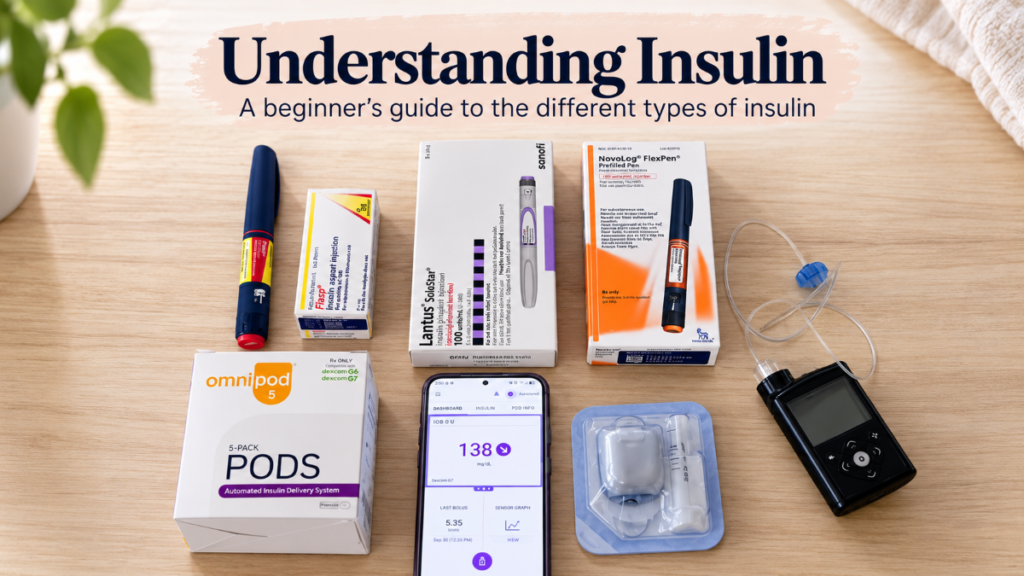

When you tell someone you have Type 1 diabetes, you sometimes realize how many Type 1 diabetes misconceptions still exist.
I’ve been living with Type 1 diabetes since I was 17, and over the years I’ve heard plenty of questions, comments, and well-meaning advice that made me realize how little people sometimes know about what Type 1 diabetes actually involves.
So I thought I’d explain some of the things I wish more people understood.
This isn’t meant to be a medical guide. It’s simply a combination of basic information about diabetes and my own experience of living with Type 1 diabetes for nearly two decades.
Because diabetes isn’t just one thing. There are different types of diabetes, and they can have very different causes and treatments.
First, What Are the Different Types of Diabetes?
When people hear the word “diabetes,” they sometimes think of it as one condition. But there are different types of diabetes, and they don’t all develop for the same reasons or require the same kind of treatment.
The three main types are Type 1 diabetes, Type 2 diabetes, and gestational diabetes.
Here’s a simple overview:
- Type 1 diabetes
- Type 1 diabetes is an autoimmune condition in which the immune system attacks the insulin-producing cells in the pancreas.
- The pancreas produces little or no insulin.
- People with Type 1 diabetes need insulin every day to survive.
- Type 1 can develop at any age, although it often begins during childhood, adolescence, or young adulthood.
- Type 1 diabetes is not caused by eating too much sugar or by lifestyle choices.
- Type 2 diabetes
- With Type 2 diabetes, the body doesn’t use insulin effectively and, over time, may not make enough insulin to keep blood sugar levels normal.
- It is the most common type of diabetes.
- Type 2 can develop at different ages and is influenced by a combination of factors, including genetics, age, and other risk factors.
- Gestational diabetes
- Gestational diabetes develops during pregnancy in someone who didn’t already have diabetes.
- It happens when the body can’t make enough insulin to meet the increased needs of pregnancy.
- It usually develops around the middle of pregnancy and is typically screened for around 24–28 weeks.
- Having gestational diabetes is different from having Type 1 diabetes and being pregnant. Someone can have Type 1 diabetes before becoming pregnant and continue to have Type 1 diabetes throughout pregnancy.
There are also other, less common forms of diabetes, so these three categories don’t represent every possible cause of diabetes.
The biggest thing I wish people understood is that “diabetes” doesn’t tell you the whole story. Type 1, Type 2, and gestational diabetes can be very different experiences.
For a more detailed overview of diabetes and the different types, the CDC is a helpful resource.
1. Type 1 Diabetes Isn’t Something I Caused
One of the most common Type 1 diabetes misconceptions is that the condition is caused by someone’s lifestyle.
I was diagnosed when I was 17, and I remember how much changed after that diagnosis. Suddenly, insulin, blood sugar, food, appointments, and diabetes supplies became part of my everyday life.
Sometimes people hear the word “diabetes” and immediately think about sugar, diet, or lifestyle choices. But Type 1 diabetes is an autoimmune condition. The immune system mistakenly attacks the cells in the pancreas that make insulin. Diet and lifestyle habits don’t cause Type 1 diabetes.
That’s something I wish more people knew.
I didn’t get Type 1 diabetes because I ate too much sugar. I didn’t choose it, and I couldn’t have prevented it by simply eating differently.
Nearly two decades later, I still think this is one of the most important things to understand about Type 1 diabetes.
2. My Blood Sugar Can Change Even When I Did Everything “Right”
One of the hardest things to explain about Type 1 diabetes is that sometimes you can do everything you think you’re supposed to do, and your blood sugar still doesn’t behave the way you expected.
You can plan a meal, take your insulin, stay active, and think you’ve got everything figured out—and then your blood sugar can still go up or down.
That’s one of the things I’ve learned over nearly two decades of living with Type 1 diabetes. So many factors can affect blood sugar, including food, physical activity, stress, illness, hormones, and insulin needs.
So when someone sees a high number and assumes, “You must have eaten something you shouldn’t have,” there’s usually a lot more to the story.
Sometimes I know exactly why my blood sugar changed. Other times, I honestly don’t.
And that’s okay.
A blood sugar number is information. It isn’t a grade on how well someone is taking care of themselves.
That’s something I’ve had to remind myself too.
3. Diabetes Is a 24/7 Job
One thing that can be hard to explain to someone who doesn’t live with Type 1 diabetes is how much mental space it can take up.
There isn’t really an “off” switch.
Even when I’m doing something completely unrelated to diabetes, there can be a little part of my brain thinking about it.
Do I have enough insulin?
Do I have everything I need with me?
What is my blood sugar doing?
When did I last eat?
Am I going to go low?
What if my blood sugar suddenly goes high?
It’s not that I’m thinking about diabetes every second of every day. After nearly two decades, a lot of it has become automatic.
But automatic doesn’t mean effortless.
Diabetes care is woven into everyday life—around work, meals, exercise, travel, sleep, family, and everything else happening that day.
And sometimes that’s the part people don’t see.
You might see someone going about their normal day, but you don’t see all the little decisions and calculations happening in the background.
That’s one of the things I wish people understood: living with Type 1 diabetes isn’t just about taking insulin. It’s also about constantly making diabetes fit into the rest of your life.
4. Eating Out Can Take More Thought Than People Realize
I love eating out, but living with Type 1 diabetes can make something as simple as going to a restaurant involve a little more thought.
When other people look at a menu, they might just think about what sounds good. I might also be thinking about how the food could affect my blood sugar, when I’m going to eat, how much insulin I may need, and what the rest of the meal might look like.
And sometimes I don’t know exactly what I’m eating until the food arrives.
Restaurant portions can be different from what I’m used to at home, ingredients aren’t always obvious, and meals don’t always arrive when you expect them to. Even foods I’ve eaten before can affect my blood sugar differently on different days.
That doesn’t mean I don’t enjoy eating out. I absolutely do.
It just means there’s sometimes another layer of thinking happening in the background that other people don’t see.
I can sit at a restaurant, enjoy a meal, have a conversation, laugh with my family, and still have a little part of my brain thinking about diabetes.
That’s one of the less visible parts of living with Type 1 diabetes: ordinary things can sometimes require extraordinary amounts of thought.
And after nearly two decades, a lot of that thinking has become second nature. But second nature doesn’t mean it isn’t work.
4. I Don’t Always Need Advice
I know that most people mean well when they offer advice about diabetes. But after living with Type 1 diabetes for nearly two decades, I’ve learned that sometimes I don’t need another suggestion; I just need someone to listen.
I’ve heard everything from comments about what I should eat to suggestions about things I should try to “fix” my blood sugar.
The thing is, Type 1 diabetes isn’t something you can manage with one simple trick.
I already spend a lot of time thinking about my blood sugar, insulin, food, activity, appointments, and all the other things that come with diabetes. I don’t necessarily need someone looking at one moment of my day and assuming they know what caused a particular blood sugar number.
Sometimes the most helpful thing someone can say is simply:
“That sounds hard. How can I help?”
That’s it.
You don’t have to understand everything about Type 1 diabetes to support someone who has it. Sometimes listening without judging is more helpful than giving advice.
5. Diabetes Technology Doesn’t Mean Diabetes Is Easy
Diabetes technology has changed so much since I was diagnosed at 17.
For many years, I used insulin pens. I eventually switched to a Medtronic pump in 2024 and then to Omnipod in 2025.
I’ve also been using continuous glucose monitoring for several years. I started using the FreeStyle Libre 2 in 2020, then switched to the Dexcom G6 in 2022. After that, I moved to the Dexcom G7, and in 2026 I switched to the newer 15-day version when it became available to me.
Looking back at that progression is pretty amazing. There was a time when managing my diabetes meant relying much more heavily on fingersticks and insulin injections. Now I have technology that can continuously monitor my glucose and insulin delivery systems that have changed how I manage diabetes day to day.
Technology has made some parts of managing Type 1 diabetes more convenient for me, and finding the right setup has made a real difference during different stages of my life.
But wearing a CGM or an insulin pump doesn’t mean I don’t have diabetes anymore.
I still have to think about insulin, food, blood sugar, supplies, and all the unexpected things that can happen during a normal day.
Sometimes I think people see an insulin pump or a continuous glucose monitor and assume that diabetes is now completely automated.
It isn’t.
These tools can be incredibly helpful, but they don’t erase the work of living with Type 1 diabetes. They’ve become part of my routine—and what works for me can change as my life changes.
For me, the biggest lesson has been that the best technology is often the technology that fits the life you’re actually living.
That’s why my diabetes technology has changed as my life has changed.
6. Having Technology Doesn’t Mean I Have It All Figured Out
Sometimes people see an insulin pump or a continuous glucose monitor and assume that diabetes must be much easier now.
In some ways, technology really has made parts of my life easier. I’m grateful for that.
But having more technology doesn’t mean I always know what my blood sugar is going to do. It doesn’t mean I never have frustrating days, unexpected numbers, or moments when diabetes feels like a lot.
Technology gives me more information and different tools to work with. It doesn’t make me immune to the unpredictability of Type 1 diabetes.
And I think that’s an important distinction.
Better technology can change how you manage diabetes without changing the fact that you still have diabetes.
I’m incredibly grateful for how far diabetes technology has come since I was diagnosed. But I’m also still just a person trying to figure things out one day at a time.
7. Looking Fine Doesn’t Mean Diabetes Is Easy
One of the strange things about living with Type 1 diabetes is that most of the time, I probably look completely fine.
I can go to work, go out to eat, take care of my family, exercise, travel, laugh with friends, and carry on with my day.
From the outside, there may be nothing that makes it obvious that I’m managing a chronic condition.
But behind the scenes, there can still be blood sugar changes, insulin decisions, supplies to remember, appointments, alarms, and all the little things that come with diabetes.
I’ve learned that looking healthy doesn’t mean everything is easy.
And I think that’s true for a lot of people living with chronic conditions. You don’t always see the work someone is doing simply by looking at them.
Sometimes the strongest thing someone with diabetes can do is simply keep going with their day, even when diabetes is making that day harder.
8. Type 1 Diabetes Is Part of My Life, Not My Whole Life
When I was diagnosed at 17, it was easy to imagine diabetes becoming the thing that defined me.
But life kept happening.
I finished high school. I went to college. I completed graduate school. I got married. I became pregnant. I became a mom. I worked. I discovered new technology. And eventually, I started focusing more on getting stronger and taking care of my body.
Diabetes was there through all of those chapters.
Sometimes it made things more complicated. Sometimes it required extra planning. Sometimes it was frustrating.
But it didn’t stop me from becoming the person I wanted to become.
Type 1 diabetes is a part of my story, but it isn’t the whole story.
I think that’s one of the most important things I would want someone newly diagnosed to know.
You can have Type 1 diabetes and still have dreams, relationships, a career, a family, hobbies, adventures, and an ordinary life.
Your life doesn’t end with a diagnosis. It simply becomes a life where diabetes has to find its place.
9. Sometimes Diabetes Changes My Plans
Living with Type 1 diabetes doesn’t mean I can’t be spontaneous. But sometimes diabetes makes spontaneity a little more complicated.
I might be getting ready to leave the house and realize I need to bring extra supplies. I might be out longer than I expected and have to think about insulin, food, or my blood sugar. Sometimes I have to change what I’m doing because my body simply isn’t cooperating that day.
There have been plenty of times when I wanted to just go with the flow, but diabetes had other plans.
And that’s one of the things people may not realize. It’s not always one big diabetes-related event that feels difficult. Sometimes it’s the hundreds of tiny adjustments you make throughout your life.
You learn to plan ahead. You carry what you need. You make adjustments when something unexpected happens.
And then you keep going.
I’ve gotten pretty good at doing that over the years. But I still sometimes wish I could leave the house without having to think about diabetes at all.
10. Type 1 Diabetes Misconceptions: What I Wish People Would Do Instead
I don’t expect everyone to understand Type 1 diabetes perfectly. Honestly, even after nearly two decades of living with it, I’m still learning.
But a few simple things can make a difference.
- Ask instead of assuming. If you’re curious, it’s okay to ask questions.
- Don’t judge someone’s food. You usually don’t know the full story behind what someone is eating.
- Don’t assume a blood sugar number tells the whole story. One number doesn’t tell you how hard someone is working to manage their diabetes.
- Don’t offer unsolicited medical advice. What works for one person may not work for another.
- Don’t assume diabetes is easy because someone looks healthy. A lot of the work happens where you can’t see it.
- If someone is having a difficult day, simply ask how you can help. Sometimes that’s more valuable than trying to fix the situation.
Most importantly, remember that the person comes before the diagnosis.
I’m not “the person with diabetes” first. I’m a mom, a wife, a daughter, a friend, someone trying to stay healthy, and someone still figuring life out.
Type 1 diabetes is something I live with. It isn’t who I am.
A Note From Lady Clay
Everything shared on Lady Clay is based on my personal experiences and is intended for general informational purposes only. It is not medical advice and should not replace guidance from your doctor or diabetes care team. Diabetes can look very different from person to person, and what works for me may not work for someone else.