
When I was first learning about diabetes, one of the things that confused me most was insulin.
I knew insulin was important. I knew that without enough insulin, blood sugar could rise dangerously high. But I didn’t really understand what insulin does in the body, why there are so many different types, or why one person might take insulin before a meal while another takes it once a day.
Then I learned that there isn’t just one kind of insulin.
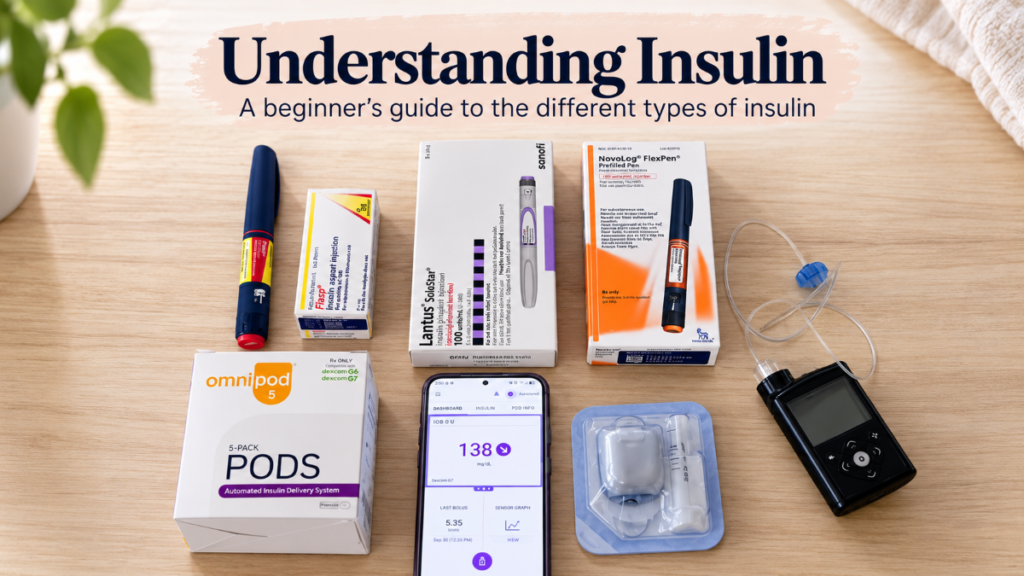
There are rapid-acting insulins, short-acting insulin, intermediate-acting insulin, long-acting insulin, ultra-long-acting insulin, inhaled insulin, combination insulin—and now, in the United States, once-weekly basal insulins for certain adults with type 2 diabetes.
And then there are insulin pens, syringes, pumps, patch pumps, and automated insulin delivery systems.
It can feel overwhelming.
So this article is my attempt to make insulin easier to understand.
This is not a guide for choosing or changing insulin doses. Insulin dosing is highly individualized and should be determined with a healthcare professional. Instead, the goal is to understand what types of insulin exist, what they generally do, and how insulin delivery has evolved.
Important: This blog post focuses primarily on insulin products and diabetes technology available in the United States. Availability, labeling, insurance coverage and age indications can change. Always check the current prescribing information and talk with your diabetes care team before changing insulin or an insulin-delivery device.
First: What exactly is insulin?
Insulin is a hormone made by the pancreas.
One of its most important jobs is to help glucose move from the bloodstream into cells, where the glucose can be used for energy. Insulin also helps suppress the liver’s release of glucose.
After we eat, carbohydrates are broken down into glucose. Blood glucose rises, and in someone whose pancreas is functioning normally, the pancreas responds by releasing insulin.
Think of insulin as part of the body’s glucose-management system.
When there isn’t enough insulin, or when the body cannot use insulin effectively, glucose can remain in the bloodstream instead of moving into cells efficiently.
That’s where diabetes comes in.
Type 1 diabetes
In Type 1 diabetes, the immune system destroys the insulin-producing beta cells in the pancreas.
People with Type 1 diabetes therefore need insulin replacement.
For many people with Type 1 diabetes, insulin is not optional. It is essential for survival.
Type 2 diabetes
Type 2 diabetes is different.
The body may still produce insulin, but it may not use insulin effectively, a problem known as insulin resistance. Over time, the pancreas may also produce less insulin.
Not everyone with Type 2 diabetes needs insulin immediately. Some people manage their diabetes with lifestyle changes and non-insulin medications. Others eventually need insulin, either temporarily or long term.
This is one reason it is inaccurate to think of insulin as a medication that belongs only to Type 1 diabetes.
The easiest way to understand insulin: Basal + Bolus
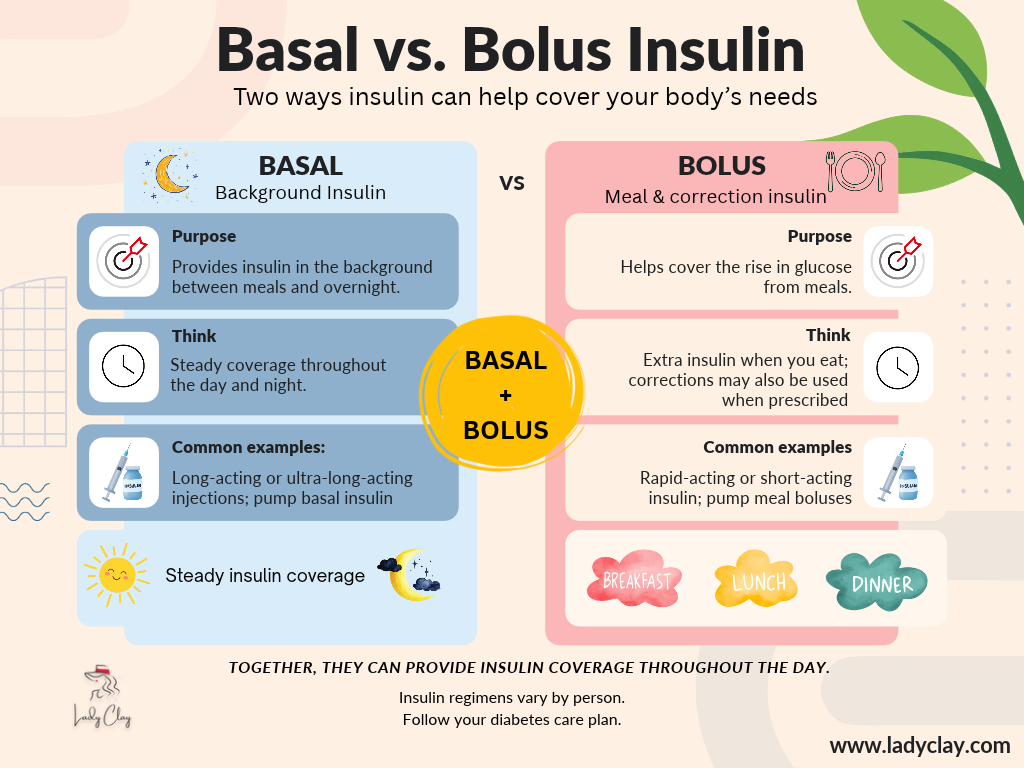
One of the most useful concepts to understand is the difference between basal insulin and bolus insulin.
Basal insulin = background insulin
Your body needs some insulin even when you aren’t eating.
Think about what happens overnight while you’re sleeping. You’re not eating, but your liver is still releasing some glucose.
Basal insulin provides background insulin coverage throughout the day and night.
Long-acting and ultra-long-acting injections are commonly used for basal insulin.
People using insulin pumps are a little different: pumps generally use rapid-acting insulin and deliver small amounts continuously as basal insulin.
Bolus insulin = mealtime/correction insulin
When you eat, you usually need additional insulin.
That additional insulin is called bolus insulin.
Bolus insulin can cover carbohydrates in a meal and, depending on the treatment plan, correct high blood glucose.
Rapid-acting and ultra-rapid-acting insulins are commonly used for meals.
The American Diabetes Association describes basal insulin as background insulin and bolus insulin as insulin used to cover meals and rising glucose. (ADA, 2026)
Why are there so many different types of insulin?
Insulin isn’t simply “on” or “off.”
Different insulin products are designed to begin working at different speeds and remain active for different amounts of time.
Three terms are especially important:
1. Onset
When does the insulin start working?
2. Peak
When is its glucose-lowering effect strongest?
3. Duration
How long does the insulin continue working?
These three characteristics make one insulin different from another.
The major types of insulin
The major categories include:
| Type | General onset | General duration | Common purpose |
|---|---|---|---|
| Rapid-acting | ~15 minutes | ~2–4 hours | Meals/corrections |
| Ultra-rapid-acting | Very quickly | ~4–5 hours | Meals |
| Inhaled rapid-acting | ~10–15 minutes | ~1.5–3 hours | Mealtime insulin |
| Short-acting/regular | ~30–60 minutes | ~3–6+ hours | Meals |
| Intermediate-acting | ~2–4 hours | ~12–18 hours | Background coverage |
| Long-acting | ~1.5–4 hours | ~24 hours | Basal/background |
| Ultra-long-acting | Several hours | 36+ hours for some products | Basal/background |
| Once-weekly basal insulin | Designed for weekly dosing | Approximately one week | Basal insulin for certain adults with Type 2 |
These are approximate ranges rather than guarantees. Individual responses vary, and product-specific labeling can differ.
The American Diabetes Association and NIDDK classify insulin by onset, peak, and duration. (ADA, 2026; NIDDK)
1. Rapid-acting insulin
Rapid-acting insulin was developed to act more quickly than traditional regular human insulin.
It is commonly used around meals.
Examples include insulin analogs such as:
- insulin lispro — Humalog
- insulin aspart — NovoLog
- insulin glulisine — Apidra
- faster-acting formulations such as Fiasp and Lyumjev
- biosimilar versions of insulin aspart, including Merilog and Kirsty
Depending on the product, you may take rapid or ultra-rapid insulin shortly before eating, at mealtime, or, in some cases, shortly after eating.
This is one reason it is important not to assume that every “rapid-acting” insulin should be taken at exactly the same time.
Why would someone use rapid-acting insulin?
A person with Type 1 diabetes may use rapid-acting insulin to cover carbohydrates in a meal.
A person with insulin-requiring Type 2 diabetes may also use rapid-acting insulin when mealtime insulin is part of their treatment plan.
Rapid-acting insulin is also the primary type of insulin used in many insulin pumps.
2. Ultra-rapid-acting insulin
Ultra-rapid insulin is designed to begin working very quickly around mealtime.
Examples include:
- Fiasp
- Lyumjev
The terminology can be confusing because “rapid” and “ultra-rapid” are not simply different strengths of insulin. They refer primarily to how quickly the insulin begins acting.
For someone who has significant after-meal glucose rises, the timing and pharmacokinetic profile of mealtime insulin can be an important part of the treatment discussion.
3. Inhaled insulin
Not all insulin has to be injected.
Afrezza is an inhaled form of human insulin that is rapidly absorbed through the lungs and is used around mealtimes.
This can provide an alternative route of administration for certain people.
However, inhaled insulin isn’t appropriate for everyone. Lung function, smoking history and other medical considerations matter, so this is something that needs to be evaluated by a healthcare professional.
4. Short-acting or regular insulin
Before today’s rapid-acting analogs became widely used, regular human insulin was a major mealtime insulin option.
Examples include:
- Humulin R
- Novolin R
Regular insulin generally starts working more slowly than rapid-acting insulin, which is why its meal timing differs.
Regular insulin can still have an important role, particularly when cost and access are major considerations.
Older human insulins can also be less expensive than newer analogs, although actual out-of-pocket cost depends heavily on insurance, pharmacy pricing, and available programs.
5. Intermediate-acting insulin
The classic example is NPH insulin.
Examples include:
- Humulin N
- Novolin N
NPH has a noticeable peak and a shorter duration than many modern long-acting basal insulins.
Because its action profile differs, meal timing, activity, and insulin doses can matter significantly.
NPH is still available and remains an important insulin option, particularly in settings where affordability and access influence treatment decisions.
6. Long-acting insulin
Long-acting insulin is generally used as basal or background insulin.
Rather than covering a meal, it provides insulin throughout much of the day and night.
Examples include:
- insulin glargine — Lantus
- insulin glargine products such as Basaglar and Toujeo
- insulin degludec — Tresiba
There are also biosimilar versions of some long-acting insulin products.
Long-acting insulin is commonly used by people with Type 1 diabetes who take multiple daily injections.
It is also widely used in Type 2 diabetes when basal insulin is needed.
7. Ultra-long-acting insulin
Some newer basal insulins are designed to provide an even longer and flatter insulin profile.
Tresiba (insulin degludec) is an example of an ultra-long-acting insulin.
The American Diabetes Association describes ultra-long-acting insulin as lasting roughly 36 hours or more, although the exact profile depends on the product and the individual.
The idea isn’t simply “longer is always better.”
The purpose is to create a predictable background insulin effect while reducing some of the fluctuations associated with shorter-acting basal insulin.
8. Once-weekly basal insulin: a newer development
This is one of the biggest changes in the insulin landscape in 2026.
Historically, people who needed basal insulin injections generally took them once or twice a day depending on the insulin and treatment plan.
That has started to change.
Awiqli — insulin icodec
In March 2026, the FDA approved Awiqli (insulin icodec-abae) as a once-weekly long-acting insulin for adults with Type 2 diabetes.
It is supplied as a U-700 prefilled pen and is designed for once-weekly subcutaneous administration.
Importantly, Awiqli’s current U.S. indication is for adults with Type 2 diabetes. It is not a replacement for the insulin needs of people with Type 1 diabetes.
Onswik — insulin efsitora alfa-gobe
In September 2026, the FDA approved Onswik, another once-weekly long-acting insulin, for adults with Type 2 diabetes.
The FDA specifically states that Onswik is not recommended for people with Type 1 diabetes because of the risk of severe hypoglycemia.
So, as of September 2026, there are two FDA-approved once-weekly basal insulin options for adults with Type 2 diabetes in the United States:
- Awiqli
- Onswik
This is a good example of why insulin information needs periodic updates. Diabetes treatment is changing quickly.
What does U-100, U-200, U-300 or U-500 mean?
This also confused me when I first learned about insulin.
The “U” refers to insulin concentration.
For example:
U-100 = 100 units of insulin per mL.
Other concentrations exist, including U-200, U-300, U-500, and the U-700 formulation used for Awiqli.
Higher concentration does not automatically mean the insulin is stronger in the sense of being more powerful per unit.
It means more insulin units are contained in the same volume of liquid.
This distinction is extremely important because insulin products of different concentrations are not interchangeable simply because the number of units looks the same.
For example, certain concentrated insulin products have specific pens, dosing systems, or restrictions.
Never substitute insulin concentrations on your own.
What are premixed insulins?
Some people don’t use separate basal and mealtime insulin.
Instead, they may use a premixed insulin containing two insulin components with different action profiles.
Examples include:
- Humalog Mix 75/25
- NovoLog Mix 70/30
- Humulin 70/30
- Novolin 70/30
- Ryzodeg 70/30
The numbers describe the proportion of the components.
For example, a 70/30 mixture contains 70% of one insulin component and 30% of another.
Premixed insulin can simplify an insulin regimen for certain people, but it also provides less flexibility than separately adjusting basal and mealtime insulin.
The right approach depends on the person’s glucose patterns, lifestyle, treatment goals, and ability to manage the regimen.
Does everyone with diabetes need insulin?
No.
This is one of the most important distinctions.
Type 1 diabetes
People with Type 1 diabetes require insulin because their bodies have little or no ability to produce the insulin needed to regulate blood glucose.
Insulin can be delivered through:
- injections
- insulin pens
- insulin pumps
- automated insulin delivery systems
- in some cases, inhaled insulin as part of mealtime treatment
Type 2 diabetes
Type 2 diabetes is different.
Some people can manage their blood glucose without insulin.
Others may eventually need insulin because their bodies don’t produce enough insulin or because other treatments aren’t enough to meet their individualized glucose goals.
Insulin can therefore appear at very different stages of Type 2 diabetes.
What about children?
Children can use insulin too, but treatment needs to be tailored carefully to their age, insulin requirements, ability to recognize and respond to hypoglycemia, school environment, and caregiver support.
For very young children, parents or caregivers often play a major role in insulin administration and diabetes technology.
The American Diabetes Association recommends offering CGM and automated insulin delivery systems to children and adolescents with Type 1 diabetes who can use them safely, either independently or with caregiver support.
Technology has therefore changed what diabetes management can look like for children compared with previous generations.
What about teenagers?
Teenagers often have a unique combination of diabetes-management challenges:
- changing insulin needs
- hormones
- school schedules
- sports and exercise
- irregular meals
- sleep changes
- growing independence
- social situations
Automated insulin delivery can help reduce some of the day-to-day burden, but it doesn’t make diabetes disappear.
The person still needs to understand their diabetes, respond to alarms, manage meals, and know what to do when technology isn’t working.
What about adults?
Adults with Type 1 diabetes may use either multiple daily injections or an insulin pump/AID system.
For Type 2 diabetes, insulin may be added when needed, sometimes as basal insulin alone and sometimes as a more intensive basal-bolus regimen.
The choice isn’t simply about age.
It can depend on:
- glucose patterns
- insulin production
- hypoglycemia risk
- lifestyle
- work schedule
- exercise
- cost
- insurance
- dexterity and vision
- personal preference
- ability to use the technology safely
What about older adults?
Older adults can use the same broad categories of insulin, but treatment often needs additional consideration.
For example, hypoglycemia can be particularly concerning in older adults, especially for someone who lives alone, has vision problems, has cognitive impairment, or takes multiple medications.
The goal isn’t necessarily to make someone’s glucose numbers as low as possible.
The treatment plan should be individualized around safety, health status, daily life, and the person’s goals.
Now let’s talk about insulin pumps
This is where insulin therapy gets really interesting.
An insulin pump is a small device that delivers insulin through a small cannula under the skin.
Instead of taking a separate long-acting insulin injection for basal coverage, many traditional pumps use rapid-acting insulin continuously.
The pump can deliver:
- small basal doses throughout the day
- meal boluses
- correction boluses
This is different from an injection regimen.
With injections, someone might take a long-acting insulin for basal coverage and rapid-acting insulin for meals.
With a pump, one rapid-acting insulin can provide both basal and bolus insulin.
What is an automated insulin delivery system?
An automated insulin delivery system—often called AID—takes insulin pump therapy a step further.
An AID system generally has three major components:
- CGM – continuously measures glucose
- Insulin pump – delivers insulin
- Algorithm – analyzes glucose information and adjusts insulin delivery
The CGM sends glucose information to the algorithm.
The algorithm evaluates the current glucose level and trend and then tells the pump whether insulin delivery should be increased, decreased or paused.
Some systems can also deliver automated correction boluses.
This is why you may hear terms such as:
- automated insulin delivery
- hybrid closed loop
- closed loop
- artificial pancreas
“Artificial pancreas” is a popular term, but automated insulin delivery (AID) is the more precise modern terminology.
How does an automated pump actually work?
Imagine glucose is rising.
Your CGM detects the rise.
The algorithm sees the glucose level and its direction.
Depending on the system’s programming and the person’s settings, it may increase insulin delivery or provide an automated correction.
Now imagine glucose is falling.
The system may reduce or suspend insulin delivery to help reduce the risk of hypoglycemia.
This can happen repeatedly throughout the day and night.
Some systems make these adjustments approximately every five minutes.
But there is an important misconception here:
Automated insulin delivery does NOT mean “diabetes on autopilot.”
Most systems still require the person to:
- announce or bolus for meals
- respond to alerts
- replace sensors and infusion sites/pods
- troubleshoot problems
- carry backup insulin and supplies
- monitor for unexplained high glucose
- know how to respond if the pump or CGM stops working
The American Diabetes Association specifically emphasizes education and troubleshooting for people using AID systems.
Omnipod 5
Omnipod 5 is a tubeless automated insulin delivery system.
Instead of tubing connecting the pump to the body, insulin is delivered from a wearable Pod.
As of 2026, Omnipod 5 is indicated in the United States for:
- Type 1 diabetes: ages 2 and older
- Type 2 diabetes: adults 18 and older
Omnipod 5 uses a compatible CGM, and its algorithm automatically adjusts insulin delivery based on glucose information.
One important detail: you still need mealtime boluses.
Omnipod 5 uses rapid-acting U-100 insulin. Current compatible U.S. insulin listings include NovoLog, Humalog, Admelog and Kirsty.
That means you cannot simply put any insulin into an Omnipod.
Pump compatibility is product-specific.
Medtronic MiniMed 780G
Medtronic’s MiniMed 780G is another automated insulin delivery system.
It combines:
- an insulin pump
- CGM
- SmartGuard technology
The current U.S. indication includes:
- Type 1 diabetes: ages 7 and older
- Type 2 diabetes: adults 18 and older requiring insulin
The system can automatically adjust basal insulin based on CGM information and can provide automated correction behavior according to its programmed algorithm.
Unlike Omnipod, the MiniMed 780G is a traditional tubed pump.
Tandem Mobi and t X2 with Control-IQ+
Tandem offers automated insulin delivery through its pump platforms using Control-IQ+ technology.
The current U.S. indication for Control-IQ+ includes:
- Type 1 diabetes: ages 2 and older
- Type 2 diabetes: adults 18 and older
Tandem Mobi is a small tubed pump that can communicate with a compatible CGM and smartphone.
The t X2 is another Tandem pump platform that can use Control-IQ+.
These systems can automatically increase, decrease or suspend basal insulin based on CGM readings and predicted glucose levels, and Control-IQ+ can deliver automated correction boluses under specified conditions.
iLet Bionic Pancreas
Another approach is the iLet Bionic Pancreas from Beta Bionics.
It is an automated insulin delivery system indicated for people with Type 1 diabetes ages 6 and older.
One unusual feature is that the system is designed to reduce the amount of traditional insulin-setting calculations a person has to make.
Instead of entering traditional basal rates, insulin-to-carbohydrate ratios, and correction factors as in many conventional systems, the iLet algorithm adapts insulin delivery based on CGM data and other inputs.
That doesn’t mean there is no user involvement—the person still interacts with the system and announces meals.
So which insulin goes into an insulin pump?
This is where people need to be particularly careful.
Pumps generally use rapid-acting U-100 insulin, not long-acting insulin.
But the exact insulin you can use depends on the specific pump and its labeling.
For example:
- Omnipod 5 has its own compatible insulin list.
- Tandem has its own compatible insulin requirements.
- Medtronic has its own labeling.
- Some rapid-acting insulins or concentrations are not approved for every pump.
The FDA specifically warns that not all rapid-acting insulins are approved for pump use and that certain concentrated formulations, such as Humalog U-200 and Lyumjev U-200, must not be used in insulin pumps.
This is one of those situations where “it’s rapid-acting insulin” is not enough information.
You need to know the exact product and the exact pump.
Why can’t I just put long-acting insulin in my Omnipod?
Because the system is designed differently.
An automated pump continuously provides rapid-acting insulin in small doses to create the person’s basal insulin coverage.
A long-acting insulin such as glargine or degludec is designed to form a prolonged background effect after injection.
Putting long-acting insulin into a pump that isn’t designed or labeled for it would not simply turn it into a different kind of pump.
It could create serious dosing and safety problems.
Always follow the pump’s specific insulin compatibility instructions.
Insulin pens vs. syringes vs. pumps
Insulin isn’t only about the medication itself.
There are several ways to deliver it.
Syringe
The traditional method.
A person draws insulin from a vial using a syringe.
Insulin pen
A pen contains insulin in a cartridge or prefilled device.
Pens can be easier and more convenient for many people and are widely used for both basal and mealtime insulin.
Insulin pump
A pump delivers insulin continuously through an infusion set or wearable pod.
Automated insulin delivery
An AID system combines an insulin pump, CGM, and algorithm to automatically adjust insulin delivery.
The American Diabetes Association recommends choosing diabetes technology based on the individual’s needs, circumstances, preferences, skills and access—not simply choosing the newest device.
Is newer insulin always better?
Not necessarily.
This is an important point that can get lost when we talk about diabetes technology.
A newer insulin may have advantages for certain people, but treatment isn’t one-size-fits-all.
Someone might prioritize:
- predictable timing
- fewer injections
- fewer lows
- flexibility around meals
- affordability
- insurance coverage
- fewer devices
- pump compatibility
- ease of use
- lifestyle
Sometimes an older human insulin may be the most accessible option.
Sometimes an insulin analog may make diabetes management easier.
Sometimes a pump may fit someone’s life better than injections.
Sometimes injections may be preferable to wearing a device.
No single insulin or delivery method is right for everyone.
A quick way to remember the insulin categories
If all of this feels like a lot, remember this:
Meal insulin
Rapid / ultra-rapid / short-acting
Think:
“I am eating, so I need insulin that acts around the meal.”
Background insulin
Intermediate/long-acting / ultra-long-acting
Think:
“I need insulin working in the background even when I’m not eating.”
Pump insulin
Usually rapid-acting U-100 insulin
Think:
“The pump is using rapid insulin to create both basal and bolus coverage.”
Automated insulin delivery
CGM + pump + algorithm
Think:
“The system uses glucose information to adjust insulin delivery.”
The insulin landscape is changing quickly
For decades, insulin treatment largely revolved around injections.
Today, there are many more options:
- different insulin molecules
- rapid and ultra-rapid formulations
- biosimilar insulins
- concentrated insulins
- insulin pens
- patch pumps
- tubed pumps
- CGMs
- automated insulin delivery
- once-weekly basal insulin for certain adults with Type 2 diabetes
And the list will likely continue to change.
For example, the FDA approved the first rapid-acting insulin biosimilar, Merilog, in 2025. Since then, additional insulin biosimilars have entered the U.S. regulatory landscape, including the interchangeable insulin aspart biosimilar Kirsty and the 2026 approval of Garzulys.
This competition may eventually give people more options and could affect insulin access and cost.
What I wish I had understood earlier
If I could go back to when I was first learning about diabetes, I wish someone had explained insulin this way:
Insulin isn’t one medication. It’s a whole family of medications designed to behave differently.
Some insulin acts quickly because it covers food.
Some insulin lasts much longer because it provides background coverage.
Some insulin can be inhaled.
Some insulin can be delivered through a pump.
And newer automated systems can use CGM information to adjust insulin delivery throughout the day.
Once you understand the basic idea of basal + bolus, the rest of the terminology becomes much easier to follow.
You don’t have to memorize every brand.
You just need to understand the role the insulin is playing.
A final note for anyone newly diagnosed
If you’re newly diagnosed with diabetes and the insulin terminology feels overwhelming, you’re not alone.
I remember being the person who knew I needed insulin but didn’t really understand why there were so many different kinds.
Start with three questions:
1. Is this insulin meant to cover meals or provide background insulin?
2. How quickly does it start working and how long does it last?
3. How is it being delivered – pen, syringe, pump, or automated insulin delivery system?
Those three questions can turn a confusing list of insulin names into something much easier to understand.
And if you’re considering changing insulin, insulin concentration, pump, or dosing schedule, don’t make that change based on an internet article. Insulin is a powerful medication, and the right product and dose must match the individual.
Diabetes treatment has come a long way—and understanding the basics is one of the first steps toward feeling less intimidated.
Sources and further reading
This blog post/article was researched using information from the U.S. Food and Drug Administration (FDA), the National Institute of Diabetes and Digestive and Kidney Diseases (NIDDK), and the American Diabetes Association (ADA), along with current manufacturer prescribing and safety information for insulin-delivery systems.
Because insulin products, approvals, device compatibility, and age indications can change, readers should verify current information with the FDA, their healthcare professional, and the manufacturer of their specific insulin or device.
References
- NIDDK – Insulin, Medicines & Other Diabetes Treatments – excellent beginner-friendly explanation of onset, peak, and duration.
- American Diabetes Association – Insulin Basics – useful reference for insulin categories and basal/bolus concepts.
- FDA – FDA-Approved Insulin Products – particularly useful for current products, concentrations, and pump compatibility.
- ADA Standards of Care in Diabetes-2026: Diabetes Technology – the strongest source for the pump/AID section.
- ADA Standards of Care in Diabetes-2026: Pharmacologic Approaches – useful for Type 1 insulin therapy and broader pharmacologic context.
“This article is educational and does not replace medical advice”